

This article was originally published in Cosmetics Business’ Skin Care Trend Report. Receive your copy here
The glass skin era may continue to thrive in 2026, but under the surface-level obsession for shine, far more is happening in skin care.
Consumers are increasingly scrolling past short-lived trends and viewing their routines as a ‘skinvestment’, with a focus on outcomes and long-term results, and gentle but effective formulas.
As below-the-surface skin health becomes a priority, a supported skin barrier is key.
In 2026, this shift is being expressed as ‘post-glass skin’ or ‘glass skin 2.0’, but it reflects a broader change in what consumers are looking for in skin care and where the industry is heading: towards repair, resilience, longevity and regeneration.
For formulators, suppliers and technology developers, the Cosmetics Business Innovation Awards provide an industry-wide platform to showcase and explain meaningful innovation. Entries open now!
Boots’ 2026 Beauty & Wellness Trends Report reveals that 80% of adults are adopting a preventative approach to their beauty routines, prioritising consistent, long-term care and maintenance over reactive solutions.
It also states that “skin stability is front of mind”, with 47% of consumers adapting their routine due to environmental factors and flare-ups, in the context of wider beauty and wellness regimes adapting to help build resilience mentally, physically and dermatologically.
Similarly, with the skin care category and its performance over the past year, it is beneath the surface that the true direction of trends can be seen.
Overall category growth in 2025 was nothing too remarkable: globally the skin care market grew by 4.5% to US$169.9bn according to Euromonitor International.
Skin care sales in Europe reflected a similar picture overall with 4.6% growth (albeit with some strong regional differences: France fell 4% and the UK grew by 11%) according to Circana.
Mass to the max
Yet a deeper look at what is driving growth reveals how mass market skin care is growing far faster than prestige skin care.
In the UK, mass skin care surged by 21% while premium skin care increased 7% according to Kantar (52 w/e 4 January 2026).
“It’s a flip in performance as during the previous year, premium skin care did particularly well and mass was performing behind the market,” says Matt Maxwell, Health and Beauty Business Unit Director at Kantar.
“It’s a wider trend we are seeing across beauty, due to increased consumer engagement, with 1.2 million more UK shoppers buying the skin care category than in the prior year.”
“One of the most significant developments over the past year has been the plateauing of prestige beauty, which is very much a reflection of the broader economic and cultural climate,” adds Nick Vaus, co-founder and Managing Partner of Free The Birds.
“The gap between luxury and value skin care has widened, with ‘accessible luxury’ losing relevance.
“Consumers are trading down to value-driven brands that deliver clear efficacy at lower price points, or investing in luxury, but only when brands can clearly articulate the why behind the premium.”
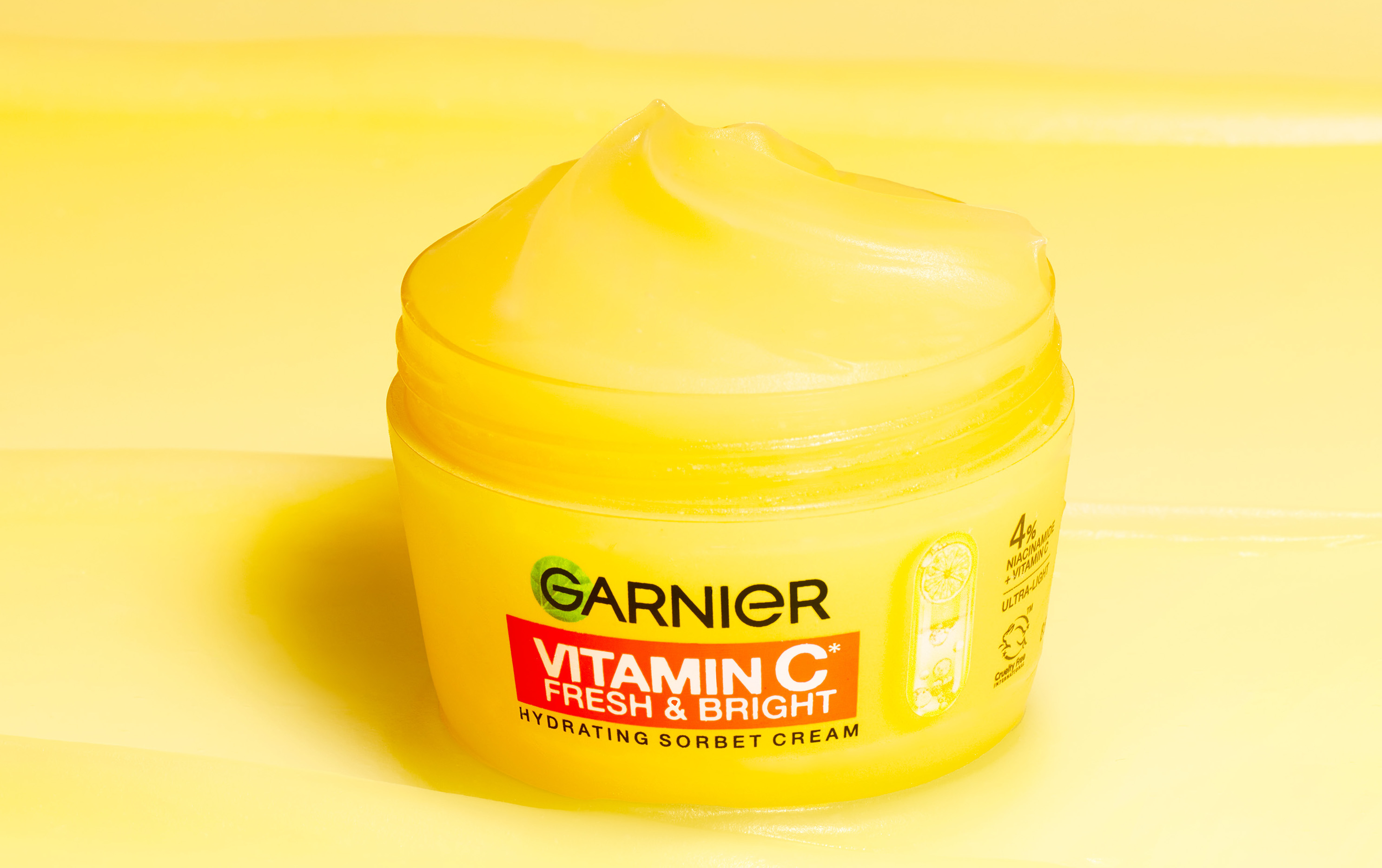
Garnier’s Hydrating Vitamin C Sorbet Cream contains 4% vitamin C
Maxwell notes that mass brands such as Nivea, Garnier and Simple have been performing particularly well in the UK over the past year due to science-backed formulas that make hero ingredients like peptides, ceramides and vitamin C a lot more accessible to the consumer, while also commanding a higher price point than traditional mass skin care.
Derma and K-beauty brands also remain dynamic segments, with growth in double digits – well above the category average.
With so many brands at mid- and mass- price point capitalising on high-performance ingredients and advanced technologies, the pressure is on prestige brands to offer something more.
Vaus says: “To differentiate, prestige brands must move beyond ingredient parity and focus on depth rather than sameness.
Storytelling around craft, innovation, and formulation expertise becomes critical. Prestige brands need to create a ‘moment’ in the consumer’s lives.”
Prestige brands must move beyond ingredient parity and focus on depth rather than sameness – Nick Vaus, co-founder and Managing Partner, Free The Birds
This is where technologies focused on targeting the root cellular causes of ageing in order to extend the skin cellular health span, like L’Oréal’s Wheel of Longevity for Beauty – which uses its proprietary Longevity AI Cloud that analyses over 260 skin longevity biomarkers – step in, resulting in the development of new products like Lancôme’s Absolue Longevity Soft Cream.
“Prestige has an opportunity to reclaim authority through trust and credibility,” adds Vaus, “Whether that is through scientific validation, dermatologist partnerships, or proven long-term results.”
Trends will be revealed in detail throughout March exclusively to subscribers, so don't miss out and subscribe.
Trend 1: Spicules
Breakout ingredients in beauty over the past year include exosomes and PDRN (polydeoxyribonucleotide). But in 2026, there is a new ingredient on the block
that appears set to take beauty by storm: spicules.
As ever, it is Korea leading the way with a wave of beauty products emerging from the country featuring this ingredient – a derivative of marine sponges.
Hailed for their microneedling-like effects, they are gaining traction on social media, often being referred to as ‘microneedling in a bottle’ and ‘liquid microneedling’.
This article will explore whether spicules are poised to have a mainstream moment.
Trend 2: Procedural skin care
Demand for aesthetic plastic surgery and treatments is skyrocketing, opening up new possibilities for pre- and post-procedure skin care solutions.
Alongside standout surgical options such as the deep plane facelift, growing demand for blepharoplasties, and a move towards more natural outcomes and regenerative treatments, aesthetic medicine in 2026 is championing treatments that work with the skin’s own repair mechanisms to improve the health and function of the skin.
The beauty industry is now witnessing robust launch activity in products positioned as companions to either aesthetic plastic surgery or ‘tweakments’. This trend explores what boxes these products should tick, and where the untapped opportunities are within this burgeoning category.
Trend 3: Beta-glucan
Alongside the broad shift toward longevity-focused skin care, consumers are prioritising barrier- supportive and moisturising formulas.
Enter beta-glucan, a natural polysaccharide widely found in fungi, bacteria and algae that is known in the medical world for supporting heart health and boosting immune function.
Studies suggest that this emerging ingredient demonstrates great potential for applications in skin care including anti-inflammatory, barrier repair, moisturisation and UV damage.
And with searches for the ingredient growing by 51% over the past year [source: Glimpse], beta-glucan is on the rise as the barrier repair hero of 2026
Trend 4: Optimised ingredient heroes
Beauty enthusiasts love a new ingredient, particularly when it comes to skin care.
From ectoin to exosomes, there is no shortage of buzzing actives for consumers to leap on.
But when it comes to skin care science, the trends that shape development are not always based on the next new thing.
This article explains how – and why – the big five hero ingredients: retinol, peptides, vitamin C, ceramides and niacinamide, are being optimised for the latest launches.
Trend 5: Medical-based skin care
Medical science has long been a source of innovation for skin care brands.
Brands such as Augustinus Bader, with its origins in wound healing, and 111 Skin, with its basis in post-surgical healing, are examples of a medical-to-skin translation.
But in 2026, this is moving to the next level. From heart transplants to brain tumour treatments, medical and surgical technology is inspiring brands including Mantle and Kyomi Skin to create next-level skin care.


