Peptides are tiny molecules with amazing properties.
Being biomimetic, and of small enough size, they are able to signal physiological changes at the dermal level if formulated in a suitable base to ensure delivery to the stratum basale.
If you can get your peptide to traverse deep enough through the epidermal layers, the ‘mimic’ peptide provided in cosmeceutical form can bind to receptors and elicit outstanding results.
If your work involves novel actives, formulation science or technical problem-solving in beauty, the Cosmetics Business Innovation Awards offer a platform designed to highlight and clearly articulate the science behind breakthrough thinking. Entries open now!
Therefore the biggest formulation issue for the cosmetic chemist is how to choose the correct peptide for the desired results, and how to formulate the base product to ensure these tiny substances travel a comparatively long way.
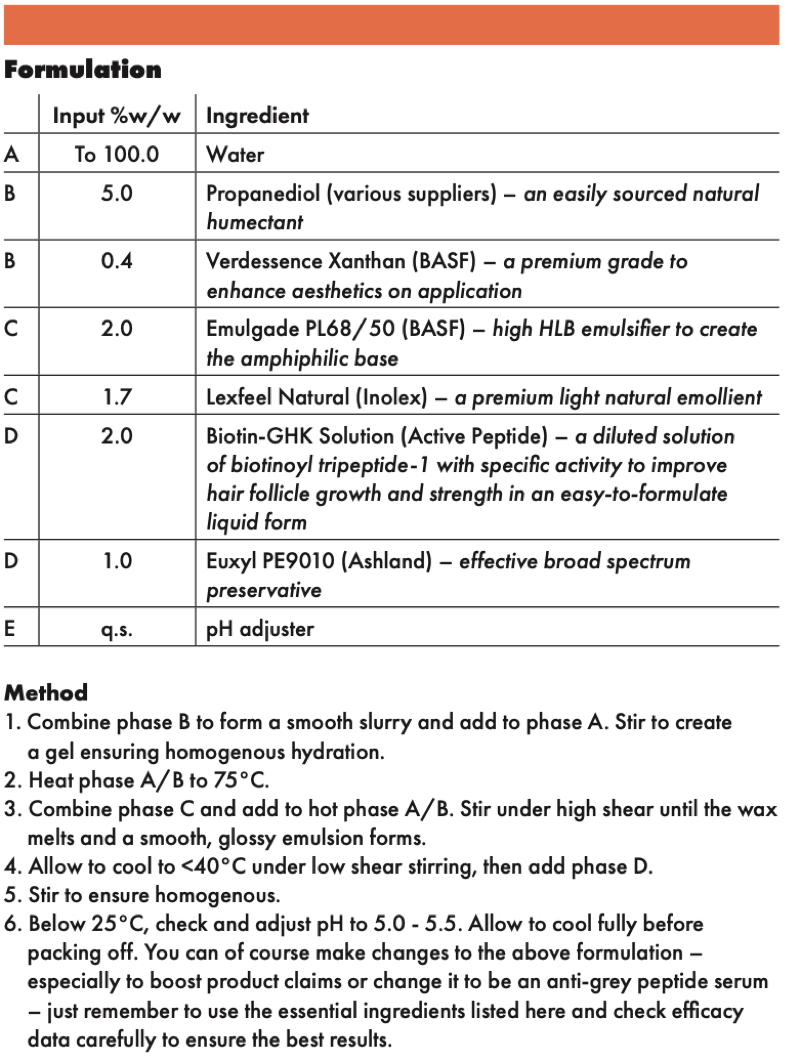
While there are peptides with specific activity to support hair growth and volumising, you can use the same principles in this how-to guide to create an anti-grey peptide serum; just choose your peptide appropriately to suit the desired results.
So, what are the essential ingredients in a hair growth peptide serum, and how should you build a hair growth peptide serum formula?
The essential ingredients
Humectant: as an osmolytic substance, humectants help carry actives to at least the mid-layers of the epidermis (stratum granulosum).
A hair growth peptide serum can use as simple a humectant as glycerin or propanediol to enhance the delivery of the active peptides.
Lightweight gelling polymer: hair growth peptide serums need to be in a non-tacky, non-greasy gel-lotion form to ensure easy application, good spreading, fast absorption and delivery of the actives.
The gelling polymer helps stabilise the formula, as well as providing the required product form which also adds to the sensory experience of the consumer.
High HLB emulsifier blend: a small input of emulsifier is essential to help create an amphiphilic base product.
This helps reduce the surface tension of the product when it is applied to the skin and enables delivery of the peptide to the deeper layers of the epidermis.
Without the emulsifier, the peptide could face delivery challenges and results may not be as desired.
Volatile or lightweight lipid: a small input of volatile or lightweight lipid is also required to ensure an amphiphilic base is created without excess greasiness.
The peptide: research your peptide carefully to ensure it has the required performance attributes and efficacy results to support marketing claims.
It is also important to carefully research the required input of your chosen peptide, as you only need a tiny amount of active material to get the desired activity; however, peptides often come highly diluted as a raw material for ease of addition to a formula.
Therefore, it is essential that you refer to the efficacy data, suppliers recommendation as well as input that yields the performance benefits that are required.
Remember to also include a broad spectrum preservative, very small input of fragrance (if desired) and antioxidants if you have used any oxidisable materials.
The final pH should also be checked carefully to ensure compatibility with all materials chosen and to match the scalp. Other extracts and vitamins may be added for marketing purposes to boost the product story.