

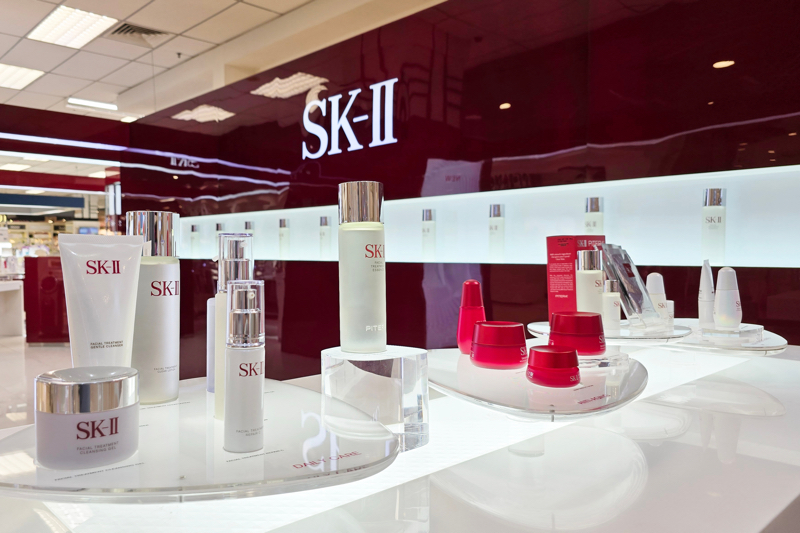
SK-II has been named the top beauty brand when it comes to influencer marketing in Taiwan, in a new ranking that aims to be the “go-to benchmark” for brand performance in Asia.
The Procter and Gamble (P&G) owned premium Japanese skin care brand topped marketing intelligence firm Kolr’s first-ever Brand Aura Index.
Luxury make-up and skin care brand YSL Beauty came second, and K-Beauty skin care brand Laniege was third, followed by Dasique, the Korean make-up line, and Rihanna’s Fenty Beauty at number five.
Rounding out the top ten were L’Oréal’s premium skin care line Lancôme, luxury fashion house offshoots Chanel Beauty and Prada Beauty, as well as Maybelline New York and The Ordinary, the affordable make-up and skin care brands, respectively.
The ranking takes into account influencer activity across platforms and measures a range of factors, including “exposure” – how visible a brand is across audiences and platforms – as well as “resonance” – how effectively a brand drives meaningful interactions and engagement.
Other measures include how consistently a brand stays active and gains traction through engaging, high-quality content, or “vitality”, and how deeply a brand connects with and is supported by its community, or “affinity”.
“The metrics that brands and agencies usually rely on to talk about marketing performance simply do not work very well for influencer marketing,” Donna Hsu, Deputy Sales Director at Kolr, told Cosmetics Business.--ABSTRACTEND-
“In creator campaigns, brands work with influencers of very different sizes and pursue multiple goals at the same time, such as awareness, engagement, and sales,” said Hsu.
“These goals often overlap within a single campaign or across a small number of campaigns, which makes performance hard to explain using traditional metrics.”
This challenge for brands prompted Kolr to launch its own unified measurement of the creator economy, giving brands “a simple, standardised way to understand their performance and clearly see where they stand in the market”, added Hsu.
Brand Aura Index was chosen as a name to represent “more than a metric”, she added.
“It captures the cultural pulse behind that authenticity,” she said.
“Aura reflects whether a brand truly exists within the conversation, whether it feels current, credible, and worth engaging with in the moment.”
What is behind brands performing well in the Brand Aura Index?
In the inaugural ranking, SK-II’s most engaged campaign was with male influencer Ivan Chang.
“We think that SK-II came out on top because it had a better feeling for the rhythm of the market,” said Hsu.
“Instead of sticking to traditional female-only skin care messaging, the brand leaned into a more inclusive idea of self-care that feels relevant and authentic.
“Its collaboration with male creator Ivan Chang felt natural rather than forced, which helped build real trust and engagement.”
Meanwhile, Dasique’s strong performance came as a surprise given its relatively limited offline presence in Taiwan, the company said, offering other brands something to learn from.
“Dasique previously operated solely through its online store and only entered physical retail for the first time in October 2025, and only through pop-ups.
“Despite this, Dasique delivered amazing results in Q4 (as per the Brand Aura Index) by executing a highly focused creator collaboration strategy.
“Instead of relying on high-profile influencers, the brand leaned heavily into large-scale micro influencer partnerships.
“They were really precise in their targeting younger female audiences and tapping into Taiwan’s growing interest in K-pop aesthetics.”
The launch index covers the fourth quarter of 2025 and will expand to include Japan in the first quarter of 2026.
Further markets in Asia are set to follow, with rankings for Singapore, Hong Kong and Malaysia potentially next, Hsu told Cosmetics Business.
“Influencer marketing is no longer a sideshow,” she said.
“It has become a core part of the modern marketing mix.
“As brands tighten budgets across traditional channels, many are choosing to double down on influencer marketing because of its ability to drive relevance, trust, and growth.
“Yet the industry faces a fundamental challenge: influencer marketing remains difficult to measure.
“Agencies struggle to clearly justify investment and impact to clients, and CMOs face the same challenge internally when explaining performance and ROI to senior leadership.”
“How your brand performs in the creator economy is a reflection of how much you are resonating, that is why it is important.
“Asia is one of the most influencer-centric markets on the planet.
“We would like the Brand Aura Index to become the go-to benchmark for brand performance in Asia.”\


