
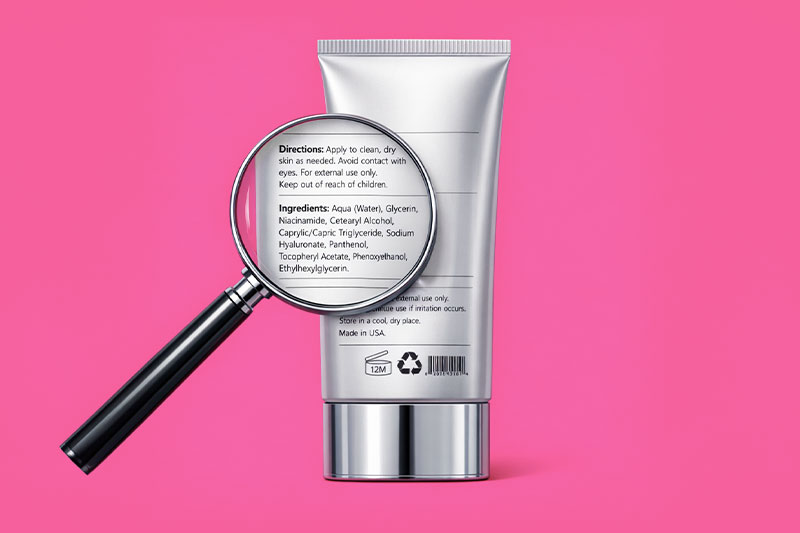
Many products encounter unexpected delays not because of formulation issues, but due to avoidable labelling mistakes. Understanding these common pitfalls can help brands streamline approvals and reduce time-to-market.
Incorrect INCI Listings and Allergen Declarations
One of the most frequent labelling issues is an incorrect ingredient list.
Ingredients must be declared using the correct INCI names and listed in descending order of concentration, with specific rules applying to ingredients present at low levels.
Common errors include:
- Misordered ingredients due to incomplete supplier documentation
- Incorrect INCI names for the intended market
- Missing preservatives or other components not declared by suppliers
- Missing fragrance allergen declarations
Requirements vary between markets. For example, some botanical ingredients may have different naming conventions in the USA compared with the UK and EU, while fragrance allergen requirements continue to evolve.
Unsupported Claims
Marketing claims are another major source of delays.
Problematic examples include:
- “Clinically proven” without adequate evidence
- “Dermatologist tested” without appropriate documentation
- Claims implying treatment or healing
- Performance claims that cannot be substantiated
All cosmetic claims should be supported by appropriate evidence and comply with the regulations of the target market.
Multi-Market Compliance Challenges
For brands selling internationally, labels must meet local requirements.
Common issues include:
- Incorrect translations
- Missing mandatory local language information
- Inconsistencies between primary and secondary packaging
- Incorrect net contents, batch coding or shelf-life information
What is acceptable in one market may not be compliant in another, making early regulatory review essential.
Packaging, Warnings and Recycling Information
Packaging design should allow sufficient space for mandatory information. Problems often arise when regulatory text becomes difficult to read or does not fit the pack correctly.
Brands should also ensure that:
- Any required ingredient warnings are included
- Recycling symbols and environmental claims are appropriate
- Labelling remains compliant across all intended markets
The Importance of Early Regulatory Review
Many labelling problems occur because regulatory considerations are introduced too late.
By involving regulatory expertise early, brands can align formulation, packaging and labelling requirements from the start, reducing delays, avoiding costly reprints and improving launch timelines.
If you are developing a cosmetic product and need support with formulation, regulatory compliance or labelling review, contact The Cosmetic Experts to help ensure a smooth and compliant product launch.
Website: www.thecosmeticexperts.co.uk
Press contact: info@thecosmeticexperts.co.uk


