


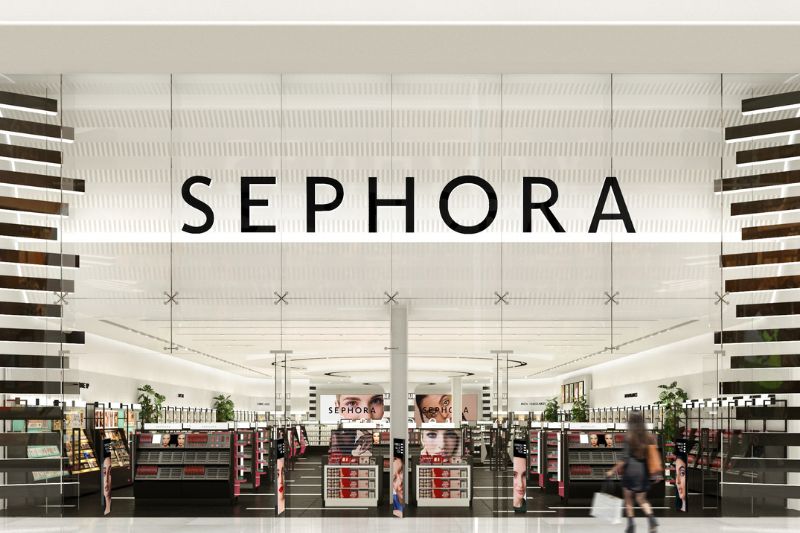
LVMH has hailed a “remarkable” performance by its international beauty retail chain Sephora in the 2025 financial year.
It comes amid an “unfavourable” environment more widely for the French luxury group, which also owns Louis Vuitton, Christian Dior, Givenchy and Benefit Cosmetics.
Sephora “continued to achieve growth in both revenue and profit and consolidated its position as world leader in beauty retail”, the company said in a statement.
Organic revenue in the group’s selective retailing division, which includes Sephora, was up 4% for the full-year ending €18.35bn.
Profit from recurring operations grew 28%, and the division’s operating margin increased two percentage points to 9.7%.
Sephora gained market share in several countries and opened around 100 stores in 2025.
LVMH also highlighted the “record-breaking” launch of Hailey Bieber’s Rhode, which made its retail debut at Sephora last year, surpassing US$10m sales in the first two days alone in the US, according to YipitData.
The selective retailing division also includes the luxury travel retail business DFS, which experienced a “major improvement in profitability” following a streamlining of operations, despite tough trading conditions.
LVMH last week agreed to sell DFS stores in Hong Kong and Macau, as well as intangible assets in Greater China.
The luxury group’s French department store Le Bon Marché posted growth, which was driven by a “differentiation strategy focused on its continuously renewed selection of products and unique array of cultural events”.
Meanwhile, LVMH’s perfumes & cosmetics business reported €8.18bn revenue in FY25, down 3% on a reported basis and flat organically.
Standouts in the period were the launch of Miss Dior Essence and Dior Homme, while Forever (a 24-hour wear foundation) and Dior Addict innovations also contributed to the stable performance.
The addition of Aqua Allegoria and L’Art & La Matière to Guerlain’s fragrance lines, and Givenchy’s new floral version of L’Interdit Parfum, also formed part of LVMH’s “robust innovation policy and highly selective retail approach”.
How did LVMH perform outside of beauty?
LVMH’s beauty divisions contributed to total revenue of €80.8bn in 2025 across the business, which also includes fashion & leather goods, watches & jewellery, as well as wine & spirits divisions.
This was down 5% on 2024 on a reported basis and 1% organically.
LVMH highlighted organic growth in the second half of the year, however, with revenue rising 1% – in line with Q3.
The “solid results in an unfavourable environment” came against a backdrop that LVMH described as a “disrupted geopolitical and economic environment”, as well as negative currency fluctuations.
Europe saw a decline in the second half of the year and the US saw growth, benefiting from solid local demand, the company said.
Meanwhile in Asia, there was a “noticeable improvement in trends: compared to 2024, showing a return to growth in the second half of the year”.
Bernard Arnault, Chairman and CEO of LVMH, said the group “demonstrated its solidity and effective strategy upheld by its highly engaged teams”, and was buoyed by loyalty and growing demand from local customers.
Highlights of 2025 included “offering customers extraordinary stores and cultural experiences”, he said.
These include The Louis, a huge cruise ship-shaped retail and cultural destination in Shanghai, China; House of Dior stores in a number of cities around the world; and new Tiffany & Co locations in Milan and Tokyo.
“In 2026, in an environment that remains uncertain, our maisons’ ability to inspire dreams – coupled with the highest levels of vigilance with regard to cost management, and our environmental and social commitments – will once again be a decisive asset underscoring our leadership position in the luxury goods market,” said Arnault.
“We will remain true to our entrepreneurial tradition as a forward-looking family group focused on sustainable creativity in high-quality products, exceptional spaces and the long-term future of our outstanding craftsmanship.”
LVMH’s share price fell as much as 7%, reflecting the somewhat mixed picture from the group, which is considered a bellwether of the luxury market.
“LVMH delivered a Q4 sales print that was broadly in line with expectations in our view for fashion & luxury, with a better watches & jewellery and selective retailing offsetting a weaker wine & spirit division,” said Deutsche Bank analyst Adam Cochrane.
“Taking a bigger picture view, over half the 9% decline in group EBIT year-on-year was driven by negative FX impacts and the free cash flow generation was robust at €11.3bn, up 8% year-on-year.”
Fears of a weaker China did not materialise, he said, with local Chinese demand remaining at a similar level to Q3.
“Looking into H126, the sales comparisons for fashion & leather goods especially are much easier and the tight cost control seen in 2025 is likely to be maintained,” said Cochrane.
“The weakness in wine & spirits should not be overplayed given it is increasingly less relevant to the group.
“This is outweighed by the improvements in fashion & leather goods and watches & jewellery.”


