People can recognise the look they want long before they can describe it, and the brands that close this gap are the ones that can turn inspiration into action.
Every stylist knows this moment: a client sits down, takes out their phone and holds up a picture, saying: ‘this, but on me’.
It is a perfectly reasonable request, but a surprisingly difficult one. The cut has a name, the colour has a formula and the finish has a technique, but the photo alone does not provide any of those details.
That gap between seeing and saying is now beauty’s real bottleneck.
Without the words for the cut, shade, nail shape or finish, the idea stalls. It becomes a screenshot sitting in a camera roll rather than an appointment in the diary or a product in a basket.
For an industry that has spent years competing to be discovered, getting seen is no longer the hardest part.
Beauty’s next competitive advantage is helping people name, request and act on what they can see.
And the gap is widening because beauty has never been more specific.
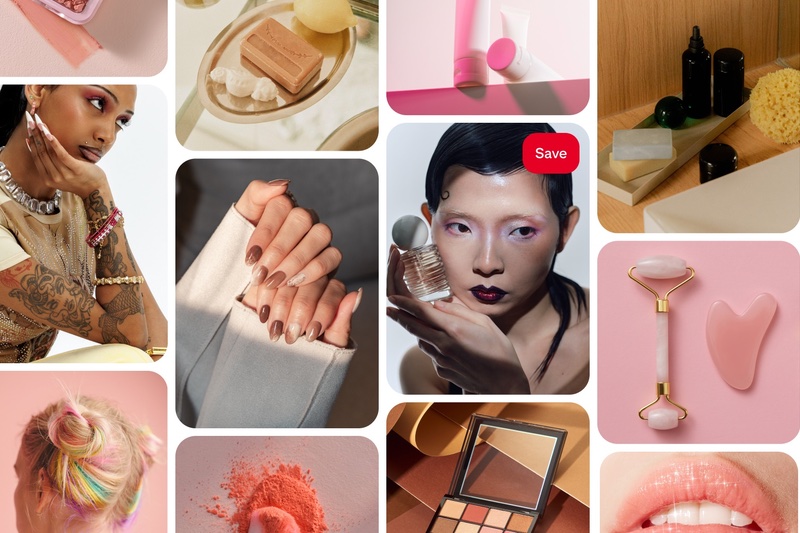
Grid artwork from Pinterest's Beauty Trend Report
Turning beauty inspiration into action
On Pinterest, it is not just a bob but a ‘textured French bob’ [based on global text-based searches from July 2025 versus July 2026], while hair colour sits somewhere between copper and espresso, with searches for ‘mocha balayage’.
It is also more than simply a red manicure, it’s a ‘dark red cat eye design’, [found Talk Shoppe, US, 2025 beauty research, August 2025, commissioned by Pinterest].
Beauty is getting more precise and personal, and the detail is where the desire lives.
That behaviour often shows up on Pinterest first. More than 85% of weekly Pinterest users say they discover beauty trends or ideas on the platform before seeing them elsewhere.
People come with an image rather than a keyword in mind.
Pinterest Intelligence helps interpret those visual signals earlier, combining first-party insights, visual understanding and purpose-built artificial intelligence (AI) to surface trends while they are still forming.
It is part of a wider shift. Search is changing in a way that it has not for decades, as people move from text-based searches towards visual-first discovery.
Beauty is where this matters most because so much of the category depends on visual nuance.

'Textured French bob' searches are up on Pinterest
Discovery still matters, but specificity is what wins
Closing that gap is now as much a technology question as it is a creative one. That is where ‘Beauty Guides’, which we recently launched in the US, comes in.
It reads a hair or nail pin the way a stylist would, picking out the cut, colour, shape and finish, and translating them into what to actually ask for at the salon.
That matters because in beauty, confidence in the request is often as important as confidence in the product.
When people can articulate a look more precisely, stylists can respond more effectively, shoppers can buy with more clarity, and brands are less likely to lose demand in the gap between inspiration and action.
The commercial lesson for brands is to design for image-first journeys – creative that shows the look in context rather than a flat packshot, with clearer brand cues and product language built around the attributes people actually search for.
Products described using those attributes, such as shade, shape and finish, have a far better chance of being found while the idea is still forming.
Products described only in campaign language risk becoming invisible.
Discovery still matters, but in this phase translation and specificity is what wins.
The advantage belongs to brands that can turn inspiration into a clear request, so the screenshot becomes the appointment and the look someone saved becomes the one they walk out with.
That is where something discovered online enhances a life offline.
This article is written by Ayesha Mace, Senior Beauty Manager at Pinterest UK.
Related content:
- Pinterest launches beauty guides feature and first-ever Beauty Trend Report with Sephora
- Pinterest’s 2026 Men’s Trend Report: beard fade and fragrance wardrobe top beauty search terms
- Inside the modern beauty discovery dilemma and how brands can beat it
- Cool Blue to Wasabi: Pinterest unveils the five colours beauty will embrace in 2026
- Pinterest's 2026 beauty trend predictions: ‘Glitchy Glam’ and ‘Cool Blue’ set to dominate


