


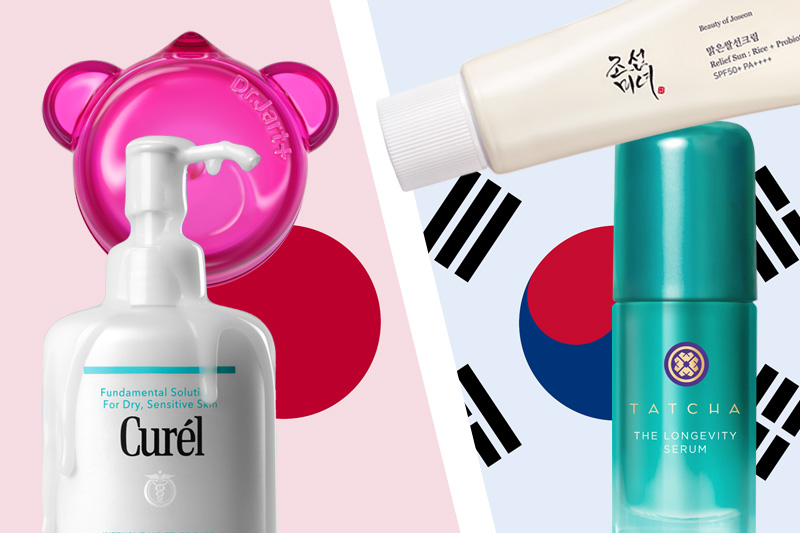
It is hard to have a conversation about the beauty industry in 2025 without mentioning the K-Beauty surge, with products, brands and rituals born in Korea taking over Western cosmetics markets and showing no signs of slowing down.
While the K-beauty takeover was a long time coming, first worming its way into Western routines through the introduction of BB creams in 2011, another Asian market is making its move after playing the long game.
Japanese products from heritage brands such as Shiseido, Tatcha and Clé de Peau have been staples in beauty cabinets for years, often without consumers even recognising their origins.
Now, J-beauty is stepping into the spotlight – but is there room for both in the Western hemisphere?
The K-Beauty Cult
In the UK and the US, the cultural impact of Korean skin care is hard to miss.
Soko Glam’s partnership with Space NK has brought cult products to the high street on both sides of the pond, while K-beauty stores are opening across London.
The numbers back this up: the global K-beauty market was valued at US $12.54bn by Straits Research in 2023 and is forecast to double by 2032, while Grand View Research revealed the UK alone generated $7.2bn in 2022, accounting for 7.8% of global sales.
For Korean brands, momentum is built on a constant stream of newness.
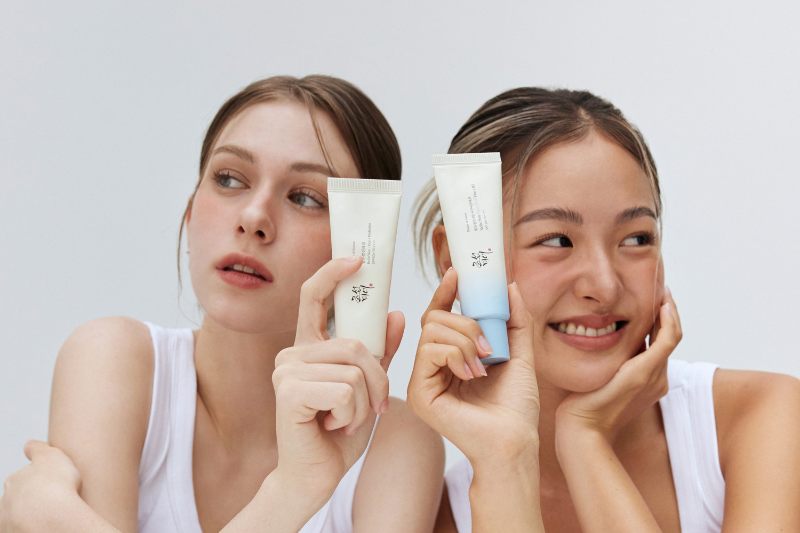
K-beauty brand Beauty of Joseon has seen huge success in Western markets
“K-beauty is bigger than ever right now, and we are seeing many Korean brands pushing innovation to new heights,” a spokesperson from Beauty of Joseon told Cosmetics Business.
“Consumers are drawn to that feeling of discovering something different from what they have tried before – There is always something exciting to discover in K-beauty.”
Dr Jart+’s General Manager, Karen Ehrlich, agrees: “K-beauty’s appeal lies in its ingredient and format innovation, playful aesthetic, and proactive skin care philosophy.
“UK consumers – especially Gen Z and Millennials – are increasingly educated and prevention-focused.
“The rise of TikTok and social commerce has accelerated discovery, turning K-beauty from a trend into a trusted staple.”
That cultural halo matters.
“Korean culture – especially K-pop, K-drama, and fashion – has played a powerful role in sparking global interest,” says Ehrlich, noting how Dr Jart+ tapped into that appeal through collaborations with K-pop band Enhypen.
Yet tradition still underpins the category.
As Beauty of Joseon puts it: “While we stay true to Korean culture and tradition, we push boundaries through hybrid product development, next-generation ingredients and advanced Korean technologies.
“For us, heritage and innovation do not compete – they elevate each other.”
K-beauty and J-beauty have distinct philosophies. K-beauty is trend-responsive and fast to market, while J-beauty leans into minimalism and tradition.
Hannah Kemper, founder of marketing agency Wonhwa, helps Korean brands launch into Western markets and grow in the UK.
She describes this global rise as inseparable from Korea’s broader cultural phenomenon: “Thanks to the ‘Korean Wave’, K-beauty is enjoying a huge amount of global interest – it is associated with K-dramas, K-pop and K-food.”
She warns, however, that growth also means competition, and adds: “As K-beauty grows in popularity, the market will become more and more saturated, so being very clear about brand identity, positioning, and differentiation is crucial.”
J-Beauty’s long game
If K-beauty thrives on speed and discovery, J-beauty takes a slower, more deliberate approach.
Future Market Insights projects the J-Beauty market to reach $35.9bnin 2025, rising to $54.7bn by 2035, underpinned by heritage brands that have been around for decades.
Linda Karlin, Kao’s Senior Director of Marketing and Strategy EMEA for the Consumer Care Business, notes how Curél points to this legacy as a strength, and says: “Heritage and refinement are elements that truly resonate with today’s consumers.
“As part of Kao we are looking back at a long history and expertise in skin care and research, which has been refined over decades.”
J-beauty has the power of timelessness. The rituals and ingredients have been refined for centuries.
Tatcha’s Chief Marketing Officer, Nicole Frusci, echoes the emphasis on time-honoured simplicity.
“K-beauty is known for fast cycles and constant newness,” she says.
“J-beauty, and Tatcha especially, is grounded in timeless principles – fewer steps, more intention, and ingredients that have stood the test of time.”
For J-beauty expert and Director of Education for Japanese-focused beauty retailer Shiko Beauty, Kyoko Getz, it comes down to philosophy.
“J-beauty is all about honouring your skin, honouring yourself, [and its] core philosophy sees skin not as a problem to solve, but as something to care for, daily, mindfully and respectfully.”
She contrasts this with the “spirit of innovation and playfulness” in K-beauty, suggesting that while Korean skin care celebrates creativity and trends, Japanese beauty offers “confidence in timeless rituals, and trust in products that prioritise skin health for the long term.”
Western perception of Asian beauty brands
Despite their differences, Western consumers often conflate the two together.
“I would not say K-beauty and J-beauty are unfairly lumped together; they are not competitors to ‘beat,’ but rather part of a wider beauty landscape,” says Beauty of Joseon.
Ehrlich takes a firmer stance, and says: “K-beauty and J-beauty have distinct philosophies. K-beauty is trend-responsive and fast to market, while J-beauty leans into minimalism and tradition.”
Getz believes visibility is the sticking point: “Many Western consumers still tend to group Asian beauty together.
“Because K-beauty is trend-forward and visible, Japanese brands can sometimes feel quieter by comparison.
“One of the biggest challenges for J-beauty in the Western market is visibility, and another challenge is education.”
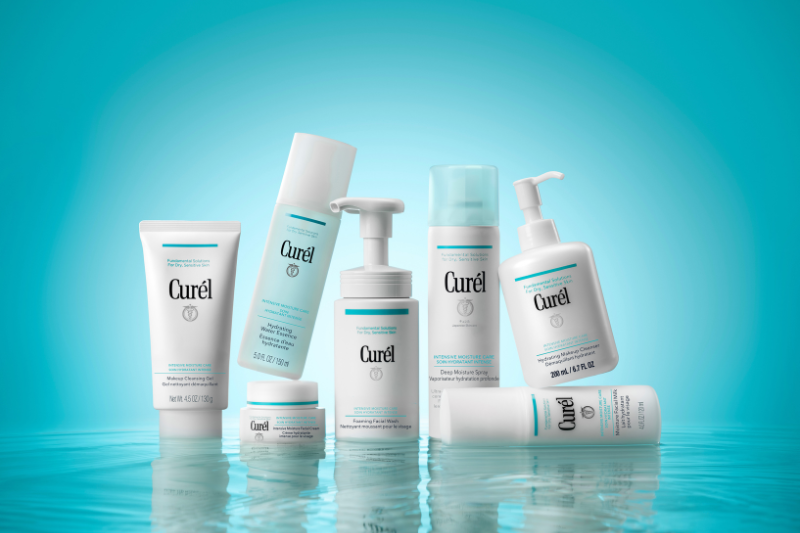
Kao brand Curél was foudned in 1999 in Japan to provide skincare for dry, sensitive skin.
Competition or complimentary?
Rather than competing, many argue that both categories can thrive side by side.
“Both J-beauty and K-beauty have gained significant traction in Western markets,” says Karlin, who sees the overlap as “a valuable opportunity”.
For Frusci, the distinction is clear: “J-beauty has the power of timelessness.
“The rituals and ingredients have been refined for centuries – less about chasing trends, more about principles that don’t change.”
Getz agrees: “I do not really see J-beauty and K-beauty as directly competing. One is about the excitement of ‘what’s new’ and the other is about reassurance of ‘what lasts.’”
Kemper highlights how K-beauty could sustain its momentum: “I think offline experiences are key to both market growth and consolidation. K-beauty is meant to be experienced.
“K-beauty needs to go from URL to IRL to make a real impact.”
The rise of TikTok and social commerce has accelerated discovery, turning K-beauty from a trend into a trusted staple.
Despite acknowledging K-beauty’s global impact, she is pragmatic about Japan’s chances: “I would say at the moment I see [J-beauty] remaining more niche, just because it does not have the cultural momentum of a ‘Japanese Wave’ propelling it globally.”
Why the West needs both
For Getz, J-beauty’s advantage lies in its subtlety, which is rooted in ritual and philosophy.
“J-beauty strengthens the skin barrier, quietly and effectively,” Getz adds.
Frusci frames J-beauty’s routines and rituals as a mindful practice: “Every ritual is a chance to pause, reconnect, and create a moment of self-love in a busy world.”
K-beauty, by contrast, brings the thrill of constant new discovery, propelled by cultural exports, TikTok virality and the willingness to experiment with formulas and ingredients to drive innovation.
Ultimately, for Western consumers, there is no need to pick sides.
Korean playfulness and Japanese heritage serve different desires: one satisfying a craving for novelty, while the other builds trust over time and tried and tested routines.
Together, they ensure Asian beauty is not a fleeting trend, instead a force reshaping the global market, each delivering strong skin care results in their own way.


