Haircare has largely not made that move. Product discovery still runs on quizzes, on shelf category logic, and on the consumer's own description of their hair.
That matters because the consumer's own description is the weakest input in the chain. Hair type, texture, and condition are things people routinely misjudge, and the answer changes with lighting, mood, and habit. A recommendation engine built on top of that input inherits its error.
Haircare has faced a longstanding personalisation challenge: hair is highly individual, yet product discovery still often relies on broad categories and trial and error.
Said Anastasia Georgievskaya, CEO & Co-Founder of Haut.AI.
Before any procurement conversation, three questions are worth answering. What can a computer vision model measure from a photograph of hair? What can it not measure? And what does the rest of the system have to do to make that output commercially useful? This piece works through all three, with a commercial example at the end.
What AI hair analysis measures from a photo
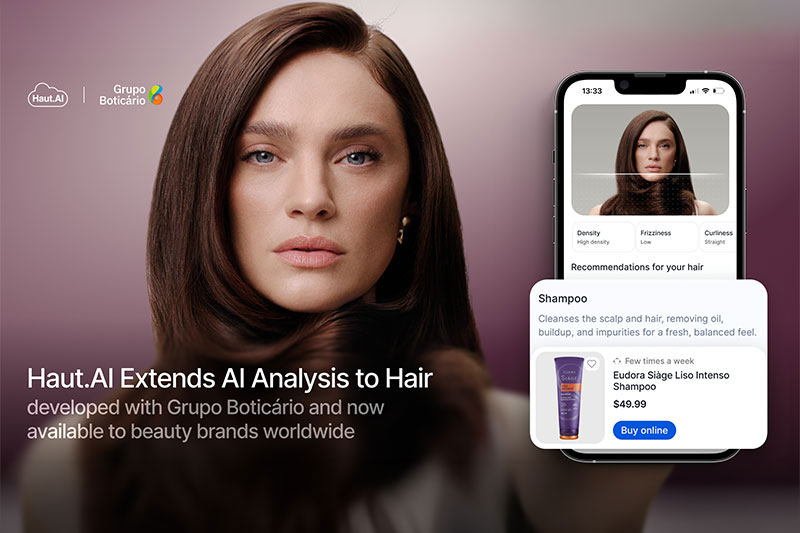
AI hair analysis measures visible hair attributes from a standardised photograph and returns them as scored values rather than self reported categories. Haut.AI's Hair Analysis, launched commercially on 1 September 2026, measures six attributes: curliness, volume, density, frizz level, colour, and colour uniformity.
All six are surface level features, read from the hair visible in the frame. Curliness is classified as straight, wavy, curly, or coily. Density is a measure of how thickly the hair sits. Colour uniformity picks up uneven colour and greying. What the list does not contain is anything requiring magnification, scalp contact, or follicle level resolution. A phone camera cannot count follicles, and no credible vendor should claim it does.
It is worth separating what the model measures from what the consumer is shown. The six attributes above are the measured output. The profile a consumer sees is broader, because it also carries context drawn from the questionnaire. When you evaluate a vendor, ask which items on the results screen are measured and which are reported. The two are not the same thing, and the distinction gets blurred quickly in demos.
The measurement is only one of two inputs. Haut.AI pairs the image analysis with a short questionnaire covering hair type, styling habits, and the consumer's primary concerns. The camera measures what the consumer cannot articulate. The questionnaire captures what the photograph cannot show, including chemical history and washing behaviour. Combined, the two inputs support recommendations across 19 hair concerns, among them dryness, frizz, split ends, hair loss, chemical damage, dandruff, lack of volume, and oily hair.
Image quality is the other dependency, and it is the one most often underestimated. Haut.AI routes capture through LIQA™ (Live Image Quality Assurance™), a guided capture layer that frames the shot and checks quality in real time before the image is analysed. It works on the front camera, the back camera, or an uploaded photo, on web and mobile, with no app install and no hardware. Without a capture standard of some kind, attribute scores are not comparable between two photographs of the same person, which makes any before and after tracking meaningless.
Why photo measurement changes the recommendation
The consumer gets a more accurate profile. The brand gets structured data it can match to its catalogue and aggregate across its audience.
Here is the practical difference between the three approaches a brand can take today:
Quiz only tools. Input is entirely self reported. Cost is near zero and deployment is immediate. Output reflects what the consumer believes about their hair, so recommendation quality is capped by the accuracy of self assessment. No repeatable baseline, so no credible before and after tracking.
Photo-based AI measurement plus questionnaire. Input combines scored visual attributes with self reported context. Runs on any smartphone, no hardware. Output is a structured profile that can be stored, re-analysed later, and aggregated across an audience. \
Clinic-based instrumental measurement. Input is captured with specialist equipment under controlled conditions. Highest resolution, including follicle level data.
Requires clinic capture and expert review, so sample sizes and throughput are constrained and consumer facing deployment is not realistic.
The second option is not a cheaper version of the third. It measures different things, at a different scale, for a different purpose. Confusing the two is the most common category error in vendor evaluation.
Where photo-based measurement sits against clinical hair methods
Photo-based AI measurement is a different instrument class from the methods used in clinical hair studies, and should not be evaluated as a replacement for them. Clinical hair studies rely on established methods including phototrichogram, TrichoScan, and trichoscopy-based systems. These are accurate but resource intensive, requiring specialist equipment, clinic-based capture, and expert review, which is what limits how many subjects a study can practically include.
On validation, ask any vendor for the methodology and the published papers rather than the summary, and check what the validation covers. Haut.AI’s algorithms are validated against clinical evaluation criteria, with methods published in peer reviewed journals, and the papers are available on request.
What a commercial deployment looks like
Haut.AI's Hair Analysis became commercially available to beauty brands and retailers worldwide on 1 September 2026, and it was developed initially with Grupo Boticário, following the beauty group's strategic investment in Haut.AI. Grupo Boticário served as the launch partner, contributing haircare science, consumer insight, and exposure to a genuinely diverse range of hair types.

Gustavo Dieamant, Executive Director of R&D at Grupo Boticário, described the collaboration in Haut.AI's launch announcement:
Hair needs are incredibly diverse, and Haut.AI has developed a solution that translates that complexity into an experience that helps consumers identify products suited to their individual needs.
The consumer facing flow completes in under one minute: guided selfie, a short questionnaire, then a hair profile and product recommendations. The recommendations map exclusively to the brand's own catalogue, tagged by the brand's team across 12 product categories running from shampoos and conditioners through treatments, masks, oils, and styling products. Results display either as a step by step routine or as a ranked product list.
The part that matters more to procurement sits behind that. Brands manage their own product inventory and tagging, configure the recommendation logic, and access aggregated insight generated from the analysis data. That aggregate layer is the underrated asset. These metrics reveal the real hair profile of a brand's audience, informing assortment, content, and formulation decisions. In other words, the output is an input to product development, not only to merchandising.
Hair Analysis runs on the same platform and recommendation engine as its AI Skin Analysis. It is an extension of existing infrastructure rather than a separate product purchase.
Five questions to ask before buying AI hair analysis
- What exactly is measured from the image, and what comes from the questionnaire? Ask which items on the results screen come from the photo and which come from the questionnaire. If a vendor will not break that down, you cannot tell how much of the result is actually measured.
- How is capture standardised? Without a guided capture layer, two photographs of the same person are not comparable, and repeat measurement is not defensible.
- What is the validation methodology, where is it published, and what does it cover? Ask for the papers, not the summary.
- Does the engine recommend from our catalogue or from a generic database? This determines whether the tool drives your sales or someone else's.
- What happens to the data, and who owns the consumer relationship? Confirm GDPR aligned handling and that the brand, not the vendor, holds the relationship.
AI hair analysis replaces the least reliable input in haircare personalisation, the consumer's own description of their hair, with something scored, repeatable, and aggregable. Whether that is worth buying depends on what sits on top of it. A measurement that feeds a generic product database is a demo. One that feeds your own catalogue, tagged by your own team, is a commerce decision.